The Chocolate Farm That Thinks Like a Winery
Aside from our Bordeaux trip, the most wine-obsessed thing we did all summer had nothing to do with wine. It was a chocolate farm on the east side of Kauai, up a red-dirt road in Kapaa, where a fifth-generation family grows cacao the way a serious winemaker grows Pinot Noir — as if the plant, the ground, and the weather were having an argument, and the farmer’s only job is to referee it honestly.
We toured Lydgate Farms in July, and it taught us a new appreciation for chocolate and its parallel to wine that we never thought about before.. Our guide, Henry, was outstanding — the kind of person who can hand you a raw seed still dripping with pulp and, three hours later, have you tasting a finished bar and understanding exactly what happened in between. If you go, ask for him. What follows is partly a love letter to a farm and partly the case that chocolate is a fermented agricultural product with a sense of place, which is to say: it is doing almost everything wine does, and hardly anyone talks about it that way. Most people know that a tour guide’s passion and enthusiasm for a topic can make or break a tour, but Henry is basically the ambassador for chocolate and made our families day!
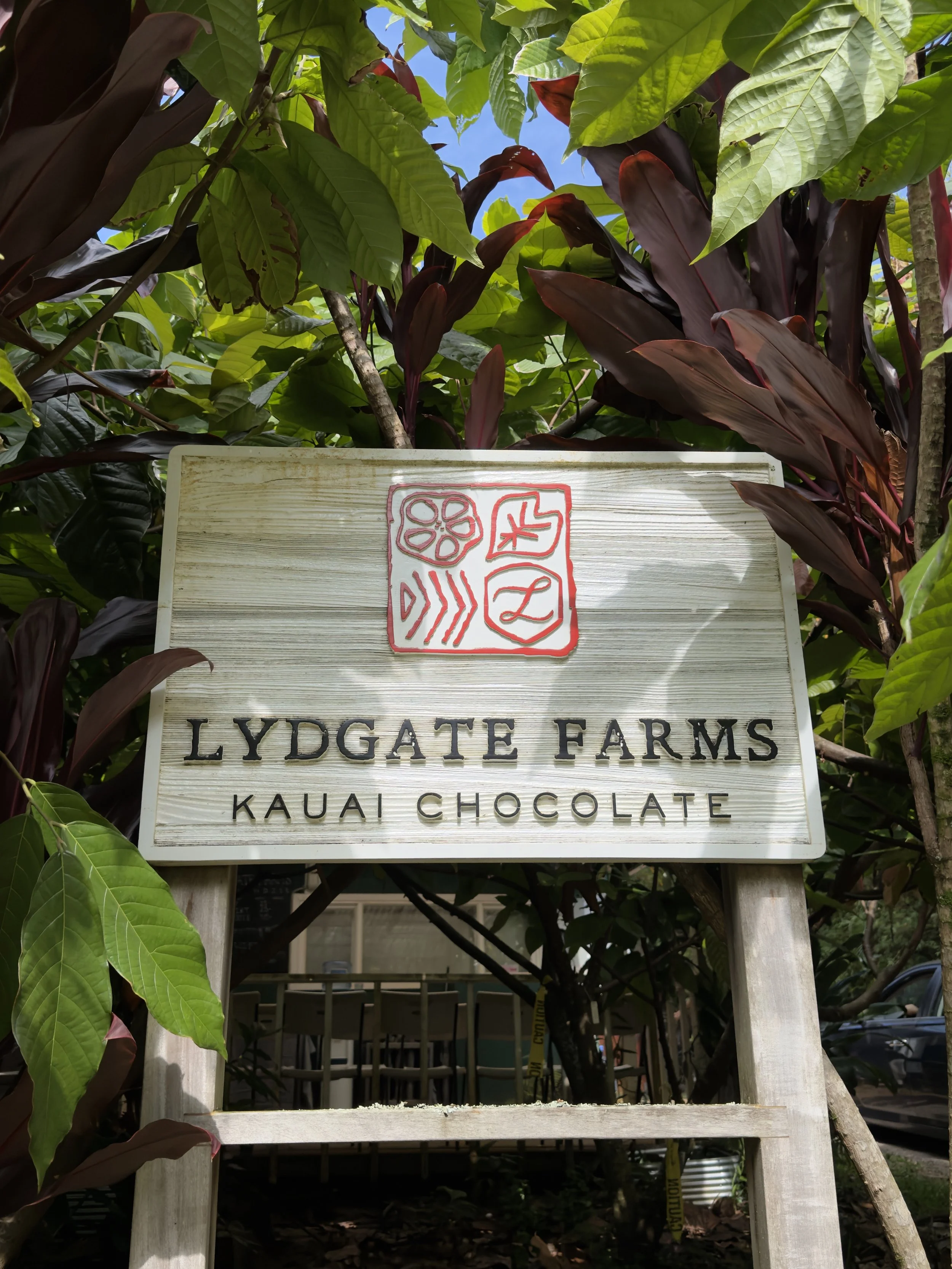
A family, a valley, and 3,000 cacao trees
Lydgate Farms sits on 46 acres in the Olohena valley outside Kapaa, and the name is not marketing. William Ludgate stepped off the steamship Egeria in 1865, the spelling drifted to “Lydgate” to honor a literary ancestor, and the family threaded itself into Hawaiian life for the next century and a half. His son, J.M. Lydgate, moved to Kauai in the 1890s and became one of those impossibly busy 19th-century figures — congregational minister, land surveyor, managing director of the McBryde sugar plantation, preservationist of native Hawaiian heiau. There is a beach park named after him. More than a dozen native plants carry the species name lydgatei. And, usefully for this story, J.M. apprenticed under the botanist William Hillebrand — the man who first brought Theobroma cacao to Hawaii in the 1850s.
The modern farm began as Steelgrass in 2008 and was renamed by Will Hibbs Lydgate, the fifth generation, who now stewards more than 3,000 cacao trees alongside award-winning vanilla and honey. This is not a hobby operation with a gift shop. In the 2023 Cacao of Excellence Awards — a blind competition that drew 222 samples from 55 countries — Lydgate’s beans were named among the top 50 in the world for the third time and took a Gold. That is roughly the chocolate equivalent of a small Kauai vineyard placing in a global blind tasting against everyone. Repeatedly.
The reason that’s even possible is a geographic accident. Cacao only fruits within about 20 degrees of the equator, and Hawaii, sitting near the northern edge of that band, is the only U.S. state that grows it commercially. When sugar collapsed, a handful of growers went looking for the next crop, and cacao — a plant a Lydgate ancestor had literally helped introduce — was waiting. The whole thing has the tidy circularity of a story someone made up, except the surveyor’s notes and the plantation records are real.
The pod, the pulp, and the moment it clicks
Here is the thing almost no one knows until they stand in front of a tree: a cacao pod, cracked open, does not smell or taste like chocolate. It tastes like fruit. Henry split one for us and the inside was a cluster of seeds wrapped in bright white pulp — Hawaiians and West Africans alike just eat it — and it was floral, tart, faintly like lychee and mango and pineapple got into a group project. There is not a molecule of “chocolate” anywhere in it. Chocolate is a manufactured flavor in the most literal sense. It has to be made, and the first step in making it is fermentation.
That was the moment the wine parallel stopped being a cute metaphor and became a description. Because a wine grape, bitten off the vine, doesn’t taste like Barolo either. Both products start as sugary fruit pulp around a seed, and both spend their formative days being eaten alive by microbes. The difference — and it’s the single most important divergence, so hold onto it — is that in wine you keep the fermented juice and throw away the seeds, while in chocolate you throw away the fermented juice and keep the seeds. Same process, opposite salvage operation.
Terroir: cacao borrowed the whole idea
The craft-chocolate world lifted the concept of terroir from wine more or less wholesale, and unlike a lot of borrowed wine language, it actually holds up. Cacao flavor is shaped by the same three levers a winemaker obsesses over: genetics, place, and the human hand after harvest. Soil, rainfall, humidity, shade trees, elevation — all of it registers in the cup, the same way Kimmeridgian limestone registers in Chablis. This is why the industry talks about single-origin bars the way we talk about single-vineyard bottlings. A bar labeled with one farm on Kauai is making the same promise as a wine labeled with one hillside in Burgundy: that where it came from is specific enough to taste.
And the descriptors track. Tasters routinely find raspberry and apricot in Madagascan cacao, and — this is a real, repeatable note, not a stretch — beans from parts of Peru that read like Sauvignon Blanc. All of that from cacao and sugar alone, no added flavoring. If you’ve ever nodded along to a sommelier finding gooseberry in a Loire white, you already accept the premise. Chocolate just never sent you the memo that it plays the same game.
Variety: the grape-list problem, in bean form
Wine drinkers organize the world by grape — Cabernet does this, Pinot does that. Chocolate has a rough equivalent in its old three-part cast: Criollo, the delicate, low-yielding, aromatic diva that growers baby the way Burgundy babies Pinot Noir; Forastero, the hardy, high-yield workhorse that makes most of the world’s bulk chocolate the way high-cropped everyday grapes make most of the world’s bulk wine; and Trinitario, the hybrid that split the difference. It is a genuinely useful shorthand.
It is also, like most tidy varietal stories, an oversimplification — and worth flagging honestly rather than repeating. Modern genetic work has mapped cacao into ten or so major clusters, and the neat three-name model papers over most of that diversity. Hawaiian cacao in particular is a genetic melting pot, largely hybrid stock with mixed parentage, so pinning a single “variety” on a Kauai farm would be its own small fiction. The honest version is closer to how we should probably talk about field blends and old mixed-planting vineyards in wine: the genetics matter, but they’re a starting point, not a verdict. What the farmer does next matters more.
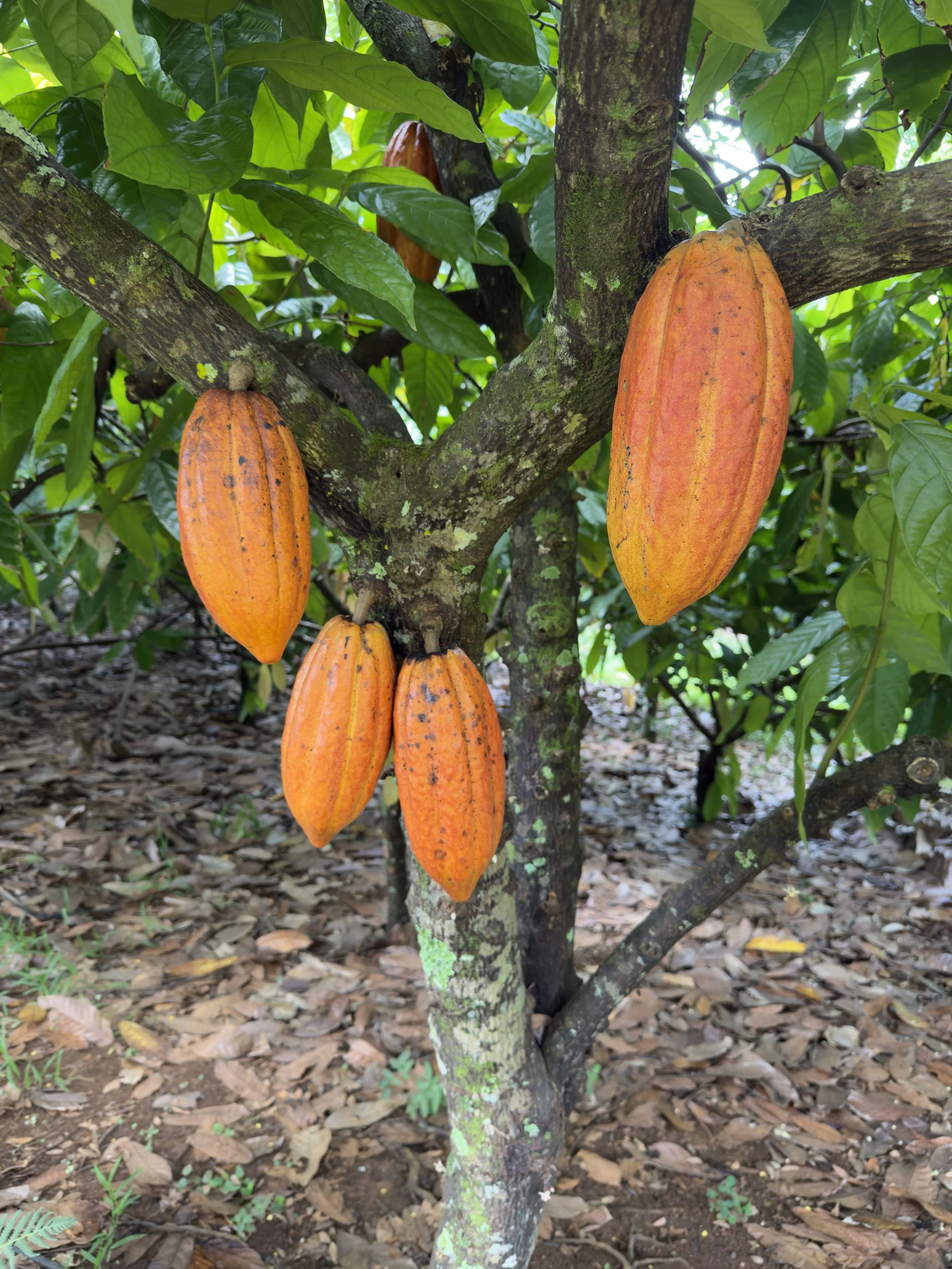
Fermentation: where the two crafts are nearly identical
This is the heart of it. When cacao seeds and their pulp are scooped into wooden boxes and left to ferment for five to seven days, the microbial choreography is one a natural-wine maker would recognize instantly. First the yeasts move in and eat the pulp sugars, throwing off alcohol — literally some of the same yeast species that ferment beer and wine — along with fruity esters and floral notes. Then, as the pulp breaks down and oxygen gets in, bacteria take over and convert that alcohol into acids, first lactic and then acetic. Yeast to bacteria, sugar to alcohol to acid: that is the same relay race that happens in a fermenter of crushed grapes, run in the same order by many of the same organisms.
The heat climbs past 120°F inside the mass, and that heat and acid do the real work. The acids seep into the seed and kill its embryo — the seed can never sprout again, which is the point — and enzymes inside start dismantling proteins into the aromatic building blocks that will later, under roasting, actually smell like chocolate. At the same time the harsh, astringent polyphenols degrade into softer brown compounds, which is why the beans shift from bitter purple to mellow brown. Fermentation doesn’t create the chocolate flavor; it creates the flavor precursors — the raw ammunition roasting later fires. Under-ferment and the bean stays astringent and dull. Over-ferment and it turns hammy and putrid. That window, and the judgment to hit it, is the whole ballgame, exactly the way picking date and fermentation management is in the cellar.
There’s even a live version of wine’s oldest argument running through cacao right now: wild versus inoculated. Most fine cacao ferments spontaneously, on ambient microbes drifting in from the farm’s own environment — which is precisely why place expresses itself so strongly, and precisely the reasoning natural-wine producers give for skipping cultured yeast. The farmer’s skill sits at the center either way. Spontaneous fermentation is not the absence of technique; it is technique you can’t buy in a packet.
Drying and roasting: élevage by another name
After fermentation comes the patient step you can ruin by rushing. The beans are spread out and sun-dried for days, and if you dry them too fast they lock in trapped acidity and turn sour — the same way a wine rushed through its raising, its élevage, keeps a green hardness it never sheds. Drying is where a lot of otherwise good cacao quietly dies, and it rewards exactly the trait good winemaking rewards: the discipline to wait.
Only then does the maker roast, crack, winnow, grind, and conch — that long, slow smoothing where dark chocolate’s texture and final aromatics resolve. If fermentation is the vineyard’s wild fruit set and drying is élevage, then roasting and conching are the cellar decisions: how much oak, how much time, how much of the maker’s own signature to layer over what the land already said. A heavy hand buries the origin. A light one lets Kauai speak. The debate over how far to push it is the chocolate maker’s version of the argument over new-oak percentages, and it is had with the same intensity.
Where the analogy honestly breaks
It would be easy to ride this parallel straight past its limits, so here are the seams. First, post-harvest processing carries more weight in chocolate than in wine. A brilliant vineyard can survive a merely competent winemaker; brilliant cacao genetics can be flattened entirely by a sloppy ferment or a botched dry. The making is a larger share of the final quality, which is humbling for anyone inclined to romanticize the plant.
Second, chocolate has no appellation system worth the name. Wine spent centuries building the legal scaffolding — AOC, DOCG, the whole apparatus — that lets a label make an enforceable promise about origin. Chocolate has single-origin marketing and very little regulation behind it, and beans routinely get blended across countries with real traceability lost somewhere between tree and mouth. So while the terroir concept is real in the glass, the consumer protections wine drinkers take for granted mostly don’t exist yet. When a bar tells you where it’s from, you are trusting the maker, not a governing body. Which, on Kauai, standing on the actual farm, is an easy trust to extend — and much harder to verify from a shelf in a store two thousand miles away.
What to actually do with this
The point of all this isn’t to make chocolate more intimidating. It’s the opposite — the same instincts that make you a smarter wine buyer make you a smarter chocolate buyer, and you already have them.
Read the wrapper like a back label. A serious bar tells you the origin (ideally a region or single farm), the cacao percentage, and who made it. That is the chocolate version of grape, place, and producer. Vague “premium Belgian chocolate” with no origin is the confectionery equivalent of a wine that lists only a brand and a color.
Taste for fermentation, not just sweetness. Let a square melt rather than chewing it. Good fermentation reads as fruit, wine, and bright acidity under the cocoa. The faults are the tells: flat astringent bitterness means under-fermented; a whiff of ham, gym socks, or vinegar means over-fermented. These are literally the same fault categories you’d flag in a flawed wine, and once you can name them you can’t un-taste them.
Fix your pairings. The most common mistake is reaching for a big dry tannic red with dark chocolate — the sugar and bitterness in the chocolate crank the wine’s tannin up to sandpaper. Match intensity and, above all, don’t let the food out-sweeten the wine. Fortified sweet reds — Port, Banyuls, Maury — or a Pedro Ximénez sherry stand up to dark chocolate far better because they bring their own sweetness to the fight. If you want a still red, keep the chocolate on the higher-cacao, lower-sugar end.
And if you’re ever on Kauai, book the farm! The Lydgate branch-to-bar tour runs about three hours, walks you through the whole 46 acres, and ends with a guided flight of chocolates from around the world set against their own. It is, structurally, a vertical tasting with a hike in the middle. Tell Henry we sent you!
The bottom line: craft chocolate is a fermented, place-driven agricultural product made by people arguing about yeast, oak, and how much to get out of the way — which is the entire job description of a winemaker. Once you’ve watched the two processes side by side, you can’t taste a single-origin bar as candy again. It reads as what it is: a vintage.