Table Wine That Embarrassed Italy: A Field Guide to Super Tuscans
If you wanted to buy the finest bottle produced in Italy in 1980, the one you were looking for was labeled "table wine."
Not a Chianti Classico Gran Selezione. Not a Brunello di Montalcino Riserva. A Vino da Tavola — the classification the Italian government reserves for wines that don't qualify for anything else. The same designation that appears on five-euro bottles sold at gas stations was sitting, for about a decade, on bottles that serious collectors were hunting at auction. That is not a labeling accident. That was a declaration.
The Super Tuscans didn't break Italy's wine rules out of carelessness. They broke them because the rules protected the wrong things — and the wines they made in the process changed what ambitious Italian wine could be.
Italy's Wine Rules, and the Problems They Created
To understand why the Super Tuscans happened, you need about ninety seconds on how Italian wine law worked in the early 1970s.
The DOC system — Denominazione di Origine Controllata — was created in 1963 with genuinely good intentions. Wine regions got official recognition, and with it came specific rules: which grapes could be used, in what percentages, how long a wine had to age, what minimum alcohol level it had to reach. Producers who followed the rules could put the appellation name on their label. Those who didn't received the consolation designation: Vino da Tavola. Table wine. No regional geography required, no vintage year needed, no implied quality signal of any kind.
The stated goal was to protect Italian regional character from dilution. The practical effect, in Chianti, was something different. By the late 1960s, Chianti as a category was drowning in cheap, overcropped production that bore the DOC stamp regardless. Some of the most internationally visible Chianti was packaged in fiasco bottles — those fat, straw-wrapped flasks synonymous with red-checkered tablecloths in American Italian restaurants throughout the 1970s — which did a thorough job of signaling "cheap and plentiful" to anyone who might otherwise wonder about Tuscany as serious wine country. The rules had calcified around a formula — Sangiovese-dominant, blended with white grapes per Bettino Ricasoli's 1872 recipe, aged in large traditional Slavonian oak casks — designed to codify historic Chianti character, but treated by a generation of producers as a ceiling rather than a floor.
Meanwhile, a handful of people were asking a pointed question: what if you wanted to plant something different? What if Cabernet Sauvignon, or Merlot, or Cabernet Franc grew particularly well on a piece of Tuscan soil — what was the best wine you could make from it?
The answer, under Italian law, was: fine. But you're making table wine.
Bolgheri: A Winemaker Plants Cabernet, and Waits
The Super Tuscan story begins not in the 1970s but in 1944, at a horse-breeding estate on the Tuscan Maremma coast — and it begins with a man who had no intention of starting a revolution.
Marchese Mario Incisa della Rocchetta managed the Tenuta San Guido estate near the small coastal town of Bolgheri, south of Livorno. He loved Bordeaux. The predominantly gravelly, stony soils at Bolgheri reminded him of the Graves district — the same mix of pebbles and clay that gives wines like Haut-Brion their iron-and-mineral backbone. In 1944, he planted Cabernet Sauvignon cuttings — reportedly sourced from Château Lafite Rothschild, per the estate's own account — on a plot called Castiglioncello at roughly 400 meters elevation.
At the time, the idea that Bolgheri could produce serious red wine was not a consensus position. The Maremma was considered too warm, too coastal, too far from the Tuscan heartland to compete with Chianti or Montalcino. The region had no wine reputation worth protecting or challenging. Incisa was not making a strategic land bet. He was making a personal wine, for himself and his family.
Then he waited. For more than two decades.
From the mid-1940s through the mid-1960s, what Incisa was making stayed entirely within the estate. He wasn't trying to sell it. He wasn't sure it was ready. The early vintages were stored in large, old Slavonian oak casks — the standard Italian approach — and the results were uneven. He spent much of the 1960s refining his planting mix through careful mass selection, narrowing focus to Cabernet Sauvignon.
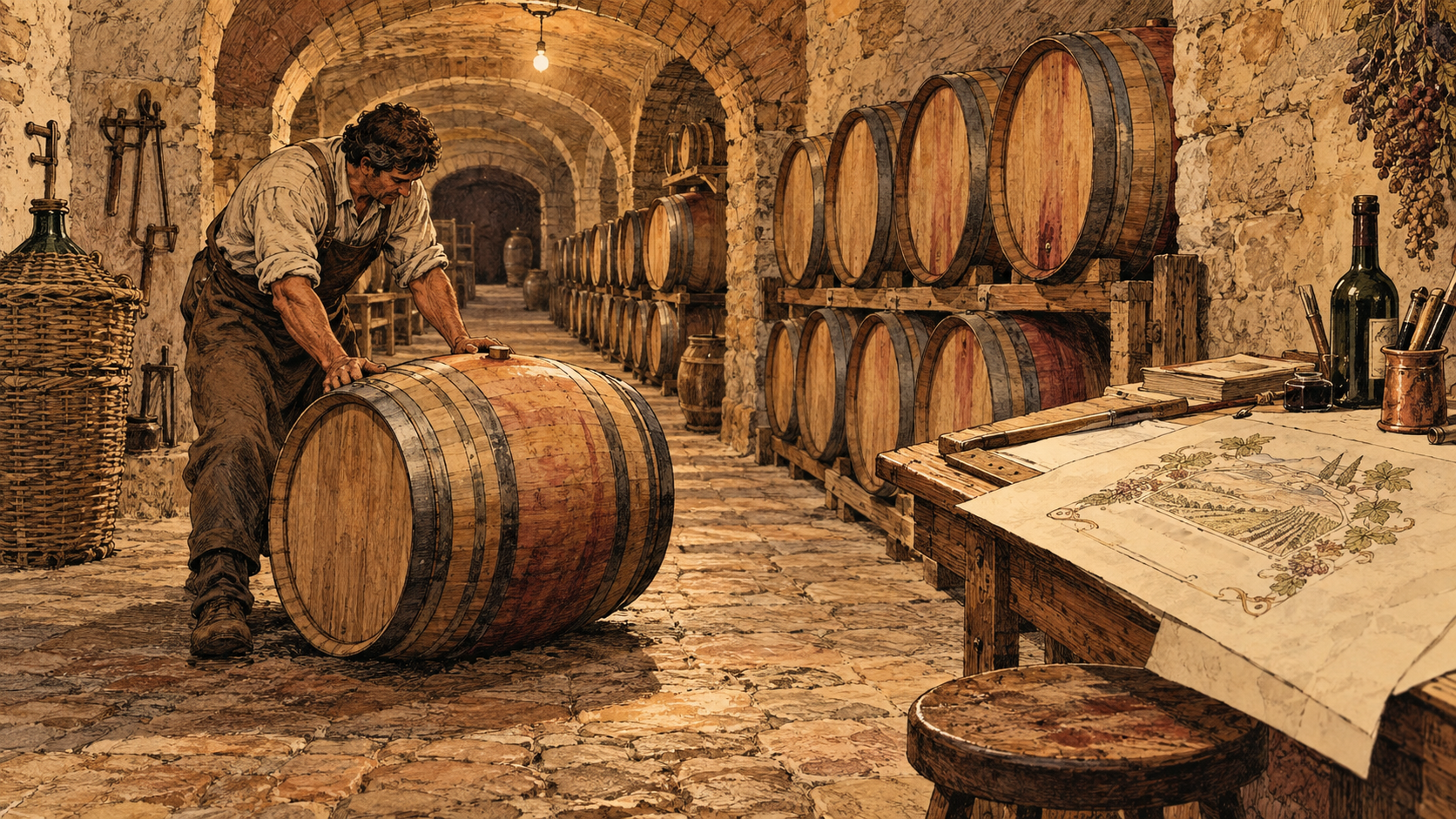
The turning point came when his nephew Piero Antinori — running the Marchesi Antinori house in Florence, a family that had been making wine since 1385 — tasted what was happening at San Guido and recognized something in it. Piero brought in Giacomo Tachis, Antinori's technical director, who had studied oenology at the Alba school in Piedmont and spent time observing winemaking in Burgundy. Tachis arrived at San Guido with ideas that were genuinely radical in the Italian context: clonal selection to identify the highest-quality plant material, controlled malolactic fermentation to manage acidity and stability, and aging in small French oak barriques rather than the large neutral casks that produced the flat, oxidative character in so much Italian red wine of the period.
By 1968, the first commercial vintage of Sassicaia was bottled. The name means "stony place" in Italian. The blend settled at approximately 85% Cabernet Sauvignon, 15% Cabernet Franc. Nothing about its composition qualified it as anything other than Vino da Tavola.
The 1968 was released commercially in 1971. Nobody in the Italian wine trade was quite sure what to do with it.
Tignanello and the Barrel That Changed Everything
While Sassicaia was finding its footing on the coast, something equally significant was happening sixty miles northeast in the Chianti Classico hills.
Piero Antinori controlled vineyards around his estate south of Florence, including one called Tignanello. In 1971, Antinori and Tachis produced the first experimental version of what would become that vineyard's namesake wine — a Sangiovese-based blend with some Cabernet added. Neither the grape combination nor the ambition was entirely without precedent. But the barrel was the problem, and also the point.
Tachis insisted on aging the wine in barriques rather than the large Slavonian casks required by tradition and DOC convention. The smaller barrels meant more oxygen contact through the wood, more tannin extraction, a different aromatic architecture entirely. Barriques also meant that the wine could not legally qualify as Chianti Classico DOC, full stop.
There was also the question of the white grapes. Chianti Classico rules at the time required a percentage of white varieties — Malvasia and Trebbiano — in the blend. This provision had been part of Italian Chianti tradition for over a century, originally designed to soften the firm acidity and tannin of Sangiovese. By the 1970s, the quality-focused consensus was that the white grape requirement was indefensible — a relic that diluted structure and aging potential. Antinori dropped them entirely.
In 1975, Tignanello was reformulated without white grapes, the blend settling at approximately 80% Sangiovese, 15% Cabernet Sauvignon, and 5% Cabernet Franc — aged in small French barriques, released under Vino da Tavola, and named after the vineyard with no accompanying appellation. Not a Chianti. Not a DOC of any kind. Just a wine.
Solaia, produced from the same estate, took the opposite blending approach — Cabernet-dominant rather than Sangiovese-dominant — and followed the same path into Vino da Tavola territory. Wine writer Burton Anderson, covering Tuscany for American audiences in the early 1980s, coined the phrase "Super Tuscan" to describe these wines. The Italian trade bodies had no category for them. Anderson gave them one anyway.
The Night Italy Lost a Blind Tasting
In 1978, Decanter magazine organized a blind tasting of Cabernet-based wines — 33 entries including respected Bordeaux estates. The 1972 Sassicaia was entered.
It won.
The result landed in wine publications across Europe with a specific kind of weight that blind tasting results carry when the winner is from somewhere nobody expected. A wine from a coastal Tuscan property that had been making Cabernet Sauvignon for barely a decade — classified as table wine by its own country's law — had outscored a field of established names in a format that stripped away every label and every association.
Italy's regulatory response was neither immediate nor enthusiastic. But the signal had been sent. And the critics were listening.
Robert Parker's 100-point score for the 1985 Sassicaia introduced the wine to a generation of American collectors who hadn't been tracking Bolgheri's development. In 2015, a case of that 1985 vintage sold at Sotheby's for $18,375. Individual bottles from that vintage now trade above $2,000. The arc from "Italian table wine" to auction record took barely thirty years — and the international blind tasting that set it in motion had nothing to do with Italian law.
In 1997, Antinori's Solaia — the Cabernet-dominant Super Tuscan from the same estate as Tignanello — was named Wine of the Year by Wine Spectator. Whatever Italy's regulatory framework thought of these wines, the market had given its answer with one of the highest-profile annual rankings in the wine world.
From Outlaw to DOC: How the Rules Caught Up
Italy's regulatory response arrived in stages, each one a formal acknowledgment of how far behind the classification system had fallen.
In the early 1980s, a second generation of Bolgheri producers built on what Incisa and Tachis had demonstrated. Lodovico Antinori — Piero's younger brother — founded Ornellaia in 1981 on a separate Bolgheri property, releasing his first vintage in 1985. Ornellaia's Bordeaux blend — Cabernet Sauvignon led, with Merlot, Cabernet Franc, and Petit Verdot — emphasized a richer texture while maintaining the coastal minerality that Bolgheri's gravelly soils consistently deliver. From a seven-hectare parcel within the estate, a pure Merlot bottling called Masseto emerged — a wine that eventually reached prices comparable to top Pomerol estates, before becoming its own independent estate entirely. The coastal strip that Mario Incisa had planted almost entirely by instinct in 1944 had become one of the most expensive wine addresses in Europe. It was still technically a table wine zone.
In 1992, the Italian government created the IGT — Indicazione Geografica Tipica — classification: above Vino da Tavola, below DOC, for wines with regional identity that don't conform to local appellation rules. Every major Super Tuscan received an upgrade from the bottom of the label pyramid to something closer to their actual market position.
In 1994, Bolgheri received its own DOC designation, with Sassicaia recognized as an official subzone. After the EU restructured subzone designations in 2013, Bolgheri Sassicaia was granted a standalone DOC appellation — the only Italian DOC named after a single wine. What began as Vino da Tavola had become, after six decades, its own regulatory category.
Tignanello and most of the inland Super Tuscans remain Toscana IGT rather than DOC wines. This is not a demotion. At this point in the market, "Toscana IGT" on a label with a recognizable proprietary name carries a quality implication that many a DOC stamp does not. The classification that once marked exclusion from Italy's system has become, in certain contexts, its own premium signal.
How to Actually Buy Super Tuscans
The Super Tuscan category runs from under $25 to well over $400, and the quality variation across that range is real. The label won't always decode it for you.
The label decoder. "Toscana IGT" on a red wine with a proprietary name is almost certainly Super Tuscan territory — or at minimum Super Tuscan-influenced. "Bolgheri DOC Superiore" marks the more coastal, internationally-styled Bolgheri wines. "Bolgheri Sassicaia DOC" means exactly what it says. If the label says "Chianti Classico," you're not drinking a Super Tuscan — you're drinking a wine that followed the rules. Both can be excellent. They taste like different wines.
Know the two styles. Bolgheri-style Super Tuscans — Sassicaia, Ornellaia, Masseto — are internationally-variety-dominant, coastal, and tend toward dark fruit, firm tannin, pronounced structure, and a savory minerality that reads as rock and sea air rather than sweet oak. They benefit from decanting at least ninety minutes when young, and reward three to five years of cellaring in most vintages. Inland Tuscany-style Super Tuscans — Tignanello, Solaia — are typically Sangiovese-dominant or blended, carrying the characteristic Sangiovese cherry-and-earth backbone with Cabernet adding structure rather than flavor. Higher acidity, more food-driven, better by the second glass with a plate of something. Tignanello in particular is one of the most food-compatible red wines in Italy at its price — its acidity cuts through fatty braised meats; its Sangiovese structure handles tomato-based sauces without flinching. The Bolgheri wines are better with beef and lamb, ideally with some time on the plate before the first sip.
Entry tier (under $35). Lucente, the second wine from the Luce estate — a joint venture between Mondavi and Frescobaldi — delivers consistent Sangiovese-Merlot character around $20-25. Campo di Sasso from Antinori in the Maremma offers Super Tuscan structure in a similar range. Le Serre Nuove dell'Ornellaia, Ornellaia's second wine, runs $40-55 and shows the Bolgheri coastal register at a fraction of the flagship price — one of the most consistent over-performers at that price point in Italian wine.
Mid-range ($60-130). Tignanello retails at $80-100 and is among the most reliable wines in its price tier in Italy. Guado al Tasso, the Antinori Bolgheri red, offers excellent coastal structure at $60-80. Guidalberto, Sassicaia's own second wine, runs $50-70 and shows genuine Bolgheri character without the flagship's cellar requirement.
Premium tier ($130+). Sassicaia retails at $150-220 depending on vintage; Ornellaia at $200+; Solaia at $150-200. Masseto starts around $350 and moves upward. Worth buying on vintage: 2016, 2019, and 2020 were particularly strong across Tuscany. In a restaurant, second wines almost always offer better value than flagships — the markup on recognizable names is steeper than on the bottles your server expects you not to know.
The Question the Labels Still Ask
Sassicaia's DOC finally arrived. The rules got rewritten. Italy's classification system, reformed and updated, now officially accommodates what it once had to reject.
But what the Super Tuscans demonstrated wasn't just that rules can be changed. It was that terroir has no obligation to respect lines drawn by committees. A coastal strip in Tuscany that barely registered on any quality wine map in 1960 became, within two decades, one of the most closely watched addresses in European wine — not because someone decreed it should be, but because a few producers were right about what that soil could do before anyone was willing to say so officially.
The best Super Tuscans are worth understanding not as rebel artifacts from a regulatory battle that's been settled, but as evidence. They are the evidence that a classification system's failure to recognize a wine's quality says nothing about the wine's quality. The label told you nothing. The bottle told you everything.
What's genuinely interesting now is watching the same dynamic play out in places Italy's establishment still hasn't fully caught up with — in the warmer reaches of Maremma, on Etna's volcanic slopes, in newer Sicilian producers pushing against the DOC framework in ways that echo what Incisa and Antinori were doing fifty years ago. The argument they made in 1975 is still being made somewhere. It just resolves faster these days, because the Super Tuscans already proved the point.